

Solution-focused hypnotherapy (SFH) uses techniques developed in solution focused brief therapy (SFBT). At its centre, solution-focused therapy is never about the problem the client comes to see the therapist about, it’s all about the outcome the client is hoping to achieve – and the progress they are hoping to make.
Whenever a client sees a therapist, the interaction between the two of them will be heavily influenced by the assumptions they both have. Solution focused brief therapy (SFBT) utilizes its own set of assumptions about clients, therapists, and the therapeutic process. Those assumptions are:
Change is a constant and inevitable. SFBT assumes that change is a continual and natural aspect of life that can occur even before a client tries therapy. It’s not the therapist’s job to initiate change, rather they concentrate on recognizing and amplifying changes already in progress.
Small changes lead to more significant changes. SFBT assumes that minor positive changes can catalyse more significant transformations. It suggests that discussing possibilities amplifies further potential, emphasizing that the starting point for change matters less than the act of picturing a future where positive differences are achieved.
The past cannot be changed. SFBT stresses present and future actions over delving extensively into past events. While acknowledging past successes, the focus is on utilizing them to construct solutions rather than dwelling on difficulties in the past.
People have the necessary resources. SFBT assumes that clients are the experts on themselves, and possess the necessary resources for change, or can develop them, often with support from others. The therapist brings their expertise in facilitating a beneficial process, however, it’s the clients’ everyday experiences that shape their understanding of what is useful.
Every individual, relationship, and situation is unique. SFBT recognizes the uniqueness of each person, relationship, and situation. Tailoring therapy to the individual client involves active client input and feedback.
What people do impacts others. SFBT assumes that small actions can have significant consequences.
Every problem has at least one exception. SFBT assumes that exceptions exist even within problems. Therefore, rather than focus on a description of the problem, SFBT focuses on the details of exceptions. Discussing exceptions is important in moving from problem resolution to solution development. If exceptions are hard to find, SFBT uses coping questions or preferred future questions.
Changes come from many directions: SFBT assumes that therapy is just one avenue for change. Research suggests that improvement between treatment sessions is common, and SFBT makes the most of the diverse resources that clients can utilize by focusing on positive developments in their lives between sessions.
SFBT uses the conversations between therapists and clients to build solutions that are appropriate to the clients. These conversations have two simultaneous focal points:
Developing a well-formed goal with the client.
Constructing a conversation to build solutions.
According to Berg and Miller (1992), there are eight guiding principles that therapists can use to indicate the effective development of well-formed goals:
Important to the client and meaningful to the therapist – goals should hold significance for the client and resonate with the therapist. Even seemingly simple goals can have a profound impact on clients.
Small and achievable – solution-focused therapists look for small, incremental changes, often already in progress, because these can lead to greater success. Starting with achievable small changes is more impactful than the size of the goal.
Concrete, specific, and behavioural – clients are encouraged to articulate goals with specific details on what will be different and how it will make a difference. Focusing on behavioural specifics enhances the clarity and achievability of the goal.
Describes the presence of behaviours – goals need to describe desired behaviours rather than what will be avoided. Clients are encouraged to say what they want to be doing, feeling, or thinking rather than what they want to avoid.
Describes a good enough beginning – SFBT therapists identify when therapy has reached a useful conclusion. Clients are encouraged to recognize a good enough start and their capacity to continue independently.
Realistic and achievable within the client’s context – goals are considered realistic and achievable based on the client’s unique life context. Encouraging clients to give details supporting the attainability of a goal makes the goal seem more real.
Observable progress or steps within a short timeframe – clients should be able to describe either current observations of the goal in their lives or outline initial steps towards the goal within a couple of weeks. Stating these steps increases the likelihood of the client achieving their goal.
Perceived as requiring effort – goals are viewed as requiring hard work, and therapists celebrate achievements made through effort.
Keeping these ideas in mind can help any solution-focused hypnotherapists to work more successfully with their clients.
The major tenets of SFBT are:
If it ain’t broke don’t fix it
If it works, do more of it
If it’s not working, do something different
No problem happens all the time – there is always an exception that can be utilized
The future is both created and negotiable
The solution is not necessarily directly related to the problem
Small steps can lead to big changes.
The language for solution development is different from the language needed to describe the problem.
One of the defining characteristics of solution-focused brief therapy is the careful use of language. Questions are deliberately phrased to direct attention towards possibilities, resources and progress rather than deficits or failures. Therapists often use tentative language such as suppose, imagine, what might, what would be different, and how would you notice. These forms of questioning invite curiosity rather than demanding certainty, allowing clients to explore possibilities without feeling pressured to provide the ‘correct’ answer. Even subtle changes in wording can encourage clients to think differently about themselves and their future. Rather than asking, “Why did that happen?”, the solution-focused therapist is more likely to ask, “What would you like to happen instead?” or “What will tell you that things are beginning to improve?” In this way, language itself becomes one of the therapeutic tools that helps clients construct their preferred future.
One of the other tenets of SFBT is that the therapist believes there is a ‘best’ version of the client that they get to talk to. This allows the therapist to carry on, even when they may be faced with resistance, denial, and non-compliance from the client. And they carry on until these difficulties disappear. And if your clients aren’t amazing people, then they will have amazing things in them that allow them to do good things. Your conversation helps them do just that.
Another important aspect of solution-focused practice is what has been called the not-knowing stance. Although the therapist brings expertise in facilitating useful conversations, they do not assume they know what is best for the client or how the client’s life should change. Instead, they remain genuinely curious, asking questions that allow the client’s own knowledge, values, and experiences to emerge. The therapist avoids interpreting, diagnosing or explaining the client’s life, recognizing that the client is the expert on their own experiences. This collaborative approach helps preserve the client’s autonomy and often leads to solutions that are both realistic and personally meaningful because they have been developed by the client rather than imposed by the therapist.
So, solution-focused therapists always work with great clients! Others might see them as just ordinary clients, but the solution-focused therapist sees the greatness in them. Part of the therapist’s job is to listen for ‘greatness’. That means that SF therapists must learn to cooperate with their clients’ capacities. They should explore instances of success. And co-construct their clients’ identities of possibility. And they should keep in mind that there is always a solution. And, if not, there is always scope for progress towards a preferred future.
The best way to achieve this is to get clients to describe their perfect future, and then help those clients to find exceptions in their current situation. The client can then see how those exceptions are part of their preferred future.
For a solution-focused therapist to be successful, they must understand the nuances of the SF approach. They must understand that a solution-focused therapist focuses on the client’s desired outcome and uses only presuppositional questions – that means the therapist always presupposes that the client will achieve their goals.
As far as SFBT is concerned, for the solution-focused approach to work, the therapist must only use the solution-focused approach and not slip into any other modalities, ever! The therapist must keep believing, keep hoping, and keep going! What can make the job hard is the fact that new clients, when they first arrive, are probably at a low point in their life. In order to help those clients make changes, the therapist does need to maintain their belief in the client. Many solution-focused hypnotherapists may, from time-to-time, try other techniques that they think will work with a client, for example neurolinguistic programming’s (NLP’s) rewind technique.
One problem many SF therapists face is that some clients will want to keep coming back to their problem. They might keep saying, “yes, but...” to every positive the therapist finds or each question (presupposing success) the therapist poses. The secret, in this situation, is for the therapist to phrase their questions in such a way that acknowledges the client’s recent difficulties in the hope that the client won’t need to repeat those difficulties as part of their answer. For example, the therapist might ask: “Given that it’s been difficult for you recently, how have you managed to...?”.
SFBT works on the assumption that clients have an outcome that they hope to achieve, and the resources to help them work towards their preferred future.
Looking at Figure 1, it’s possible to see that the structure of every solution-focused session is divided into three parts. The first part is the desired outcome. This sets out what the client wants to achieve in the session or from all the sessions. Once that has been established, the main part of the session is taken up with the description – which has four parts to it. And at the end is the closing of the session. Let’s look at those in more detail.
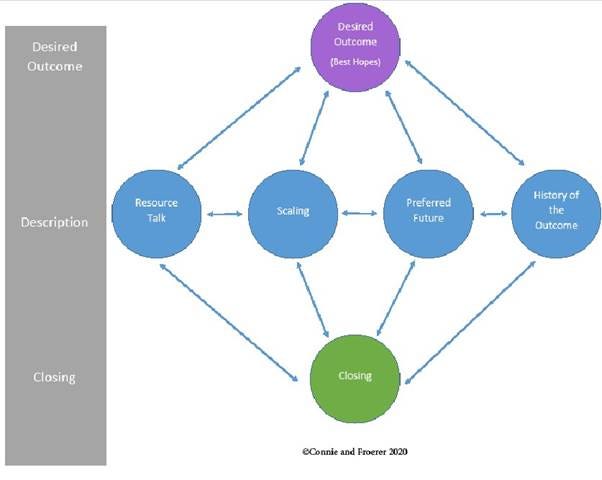
Figure 1: Connie-Froerer Diamond Model
So, the first step is to identify an outcome for the sessions – this is different from a goal. This is what the client is there to achieve. Useful questions to ask in this part are, “what is your desired outcome from this work?” Or, “what are your best hopes from this therapy?” That will identify their goal. The trouble often is that their goal won’t be under their control – for example, they might say that their goal is for people to like them. The next few questions should find an outcome that the client does have full control over. You might ask, “what difference would it make to you if ‘people liked you’?” Or you might ask, “suppose you woke up tomorrow and ‘people liked you’. How would you feel?” Taking their answer, you might ask, “how would that make a difference to your life if you were <whatever their previous answer was>?” You might then say, “suppose you woke up tomorrow and you were able to <previous answer>, and you still had <original problem>, how would you feel?”
When asking clients questions, most question are about the presence of the desired outcome and connected to the client’s resources that could make that outcome a reality. Experienced practitioners sometimes ask clarification questions, contextual questions, and relationship questions.
So, they came with a problem, you got them to suggest a goal for the work – one where the problem was solved – and, through questioning, were able to find an outcome that was under their control that they could work towards. It may not solve the problem as such, but it makes the problem so much less of a problem that it becomes unimportant.
The next stage is to move to a time when the client has experienced their desired outcome. The description section helps the client to see the presence of their desired outcome in their lives already. The description section has four component parts.
Resource talk highlights resources the client already has that can be utilized to accomplish change. Questions might be framed like, “wow, it’s must be really hard to feel x, but if I’d met you at a time in your life when you felt the most y, what resources were you drawing on from within you to help you achieve that sense of y?” From what they say, it’s possible to create a list of resources that they have used.
Scaling can be used to highlight descriptors. They will say how they feel on a scale of 0 to 10. So, a question might be framed like this: “It must be really challenging to feel x, I hope I can help in this session. On a scale of 0 to 10 where 10 represents you totally y, and 0 is the exact opposite, where would you say you are today?” They will give an answer – say n. The therapist can say: “suppose you walk out of my office and you’re an n+1, what would you notice that would tell you that you’re at an n+1 instead of an n?” Or: “Things must be really difficult. n seems very low, but it’s not n-1. What do you notice about your life that lets you know you’re not n-1?” This helps the client to identify the resource that they already have, and they are using.
If they were to say -10, the therapist can follow up by asking: “what are you doing that you’re pleased with to help you cope and manage at such a difficult time in your life?”
Their preferred future can often result from the description they give when answering the miracle question. Other questions that the therapist can ask to get the same result are: “suppose you woke up tomorrow, even though you’re having these struggles and problems, your sense of y and your sense of yourself has been returned to you, what’s the very first thing that you would notice?” Follow up questions can help the client to describe the details of the discovery of having those things come back into their life.
History of the outcome is where the client talks about the presence of their desired outcome in their life previously – ie where they’ve achieved their goal in the past. Good questions to ask include: “in the past, when your sense of y was present in your life, how did you know it?” Or: “when these things were present, how did they make themselves aware to you?” Or: “how were you aware of the presence of these things when they were present in your life in the past?”
Compliments are not just casual praise or a way to make the client feel good. They are a deliberate, strategic intervention designed to highlight a client’s strengths, resources, and successful coping strategies. Instead of focusing on what is wrong, compliments explicitly point out what the client is already doing right.
Compliments praise the client’s specific behaviours and effort rather than their personality. They are never manufactured or empty flattery. They are always directly tied to a specific fact, story, or success the client just shared during the session. They draw attention to times when the problem could have happened, but did not. This helps the client realize that the problem is not all-powerful. And they help clients view themselves as capable agents of change rather than helpless victims of their circumstances.
The therapist may directly observe and state a positive fact about the client’s progress or coping skills. Or the therapist asks a question that forces the client to compliment themselves. An example would be: “Given how difficult this week was, how did you manage to get out of bed every morning and get the kids to school on time?” Compliment can also be used to dig deeper into a success, amplifying it so the client notices the ripple effects of their positive actions.
Coping questions are a powerful, gentle intervention used when a client feels completely overwhelmed, hopeless, or stuck in a crisis. Coping questions can be used to help the client realize that even in the darkest moments, they are somehow managing to survive. They shift the focus from how bad the problem is to how the client is enduring it.
Coping questions start by validating that the client’s situation is genuinely difficult, making the client feel heard. They then gently challenge the idea of total helplessness by showing the client they are already taking action to survive. By focusing on the immediate present, they interrupt feelings of despair about the future. And they transform passive ‘enduring’ into an active, conscious strategy that the client can repeat. Coping questions are highly adaptable and usually start with “How did you...” or “What stopped you from...”.
When clients answer these questions, they are forced to shift their identity. They stop seeing themselves purely as a ‘victim of a problem’ and start seeing themselves as a ‘survivor of a problem’.
Relationship questions (also known as interactional questions) are used to invite clients to look at themselves, their resources, and their progress through the eyes of the important people in their lives. Instead of asking a client how they think they are doing, the therapist asks how a partner, a child, a friend, a co-worker, or even a pet would describe the situation.
When clients are stuck in their own negative thoughts, stepping into someone else’s shoes provides an objective view of their own progress. The questions force the client to describe concrete, observable actions rather than vague internal feelings. And they remind the client that they do not live in a vacuum and that their positive changes have a ripple effect on others. Clients are often much harder on themselves than others are. Seeing themselves through a loved one’s eyes uncovers hidden strengths. These questions are often asked at the end of the miracle question.
In standard SFBT protocol, the therapist takes a brief 5-minute break near the end of the session to compose a feedback message. This message almost always begins with a series of compliments. This validates the client’s hard work, builds a strong therapeutic alliance, and primes the client’s mindset. It ensures that when the therapist suggests a small ‘task’ or next step, the client feels competent and motivated enough to actually try it.
One problem with asking clients questions is that they may reply saying that they don’t know the answer. Often, a “don’t know” answer indicates that the client has thought about this question before. It’s important not to make the person feel defensive or they will never move from their “don’t know” answer. You could ask them what they think the answer might be. Perhaps better is to ask them what small change a significant person in their life, or a pet, who knows them so very well, might notice. Because the person, or pet, knows them so well, they are bound to notice any change, and it is easier for the person to answer the question. And so you have successfully moved on from the “don’t know” answer.
For people who are stuck and can only see the problem, here’s the question to ask: “What would you like to feel instead?”
The closing part of the session is important because it provides a way to maintain the client’s autonomy. They are not relying on the therapist to come up with all the answers. A good thing to say would be: “Thank you for coming, I hope it was useful. Before our next session, I want you to look for evidence or signs of change.” Remember: a change is only a change if it’s noticed! Once a client notices a change, they are able to achieve more changes.
One of the great ‘discoveries’ of de Shazer and the Milwaukee team was that ‘solutions’ had more in common with each other than they do with ‘problems’.
One of the great techniques that comes from solution focused brief therapy is a way to help a client to be the best version of themselves that they can be. When a person has an event coming up, especially an event that will have a substantial impact on their life (eg job interview) and where their performance at the event will have a significant impact on the outcome, then ‘being at their best’ during the event is likely to make a difference to their future life.
The experience of ‘being at their best’ during an interview frees the client from a sense of responsibility for the outcome, or, more particularly, a bad outcome that might otherwise have led them to blame the misfortune on themself.
This technique is very useful for events involving strangers and containing unpredictable elements. In these cases, it is not possible for the client to describe the event in great detail because there are too many unknowns. For key events with known participants, such as a team meeting, it’s possible to build an accurate ‘at your best’ picture of the event itself. Whatever the situation, the technique begins with an ‘at your best’ description from the start of the day, it includes the ‘successful’ meeting, and perhaps finishes with arriving home at the end of the day. In this way, a key but isolated event is embedded in a client’s wider daily life and has available a wider array of potential resourcefulness.
When using this technique, the client is asked to describe both their inner states and the outer actions that signify these states. They are asked to locate themself at specific places and specific times, and attention is paid to the most humdrum details such as the period during which their computer turns on or while sitting on a train. They are asked to think about what this will look like to others (who may well be strangers or even pets), and how these others might respond. In the middle there is the opportunity to list some of the reasons why the client might be justified in feeling confident and how to deal with any setbacks that might be part of the vagaries of life.
The client leaves the session with no more than they came with: they are asked to describe nothing that was not already within their experience of themselves – no ‘miracles’, no imagining they can do something they’ve never done before, just simply a description of what they might ordinarily do on one of those days when they are at their best.
However, what makes this technique so special is the extraordinariness of the questions and therefore the never-before-spoken answers. The client is unlikely to have been asked what a stranger might notice about them, so their answer is likely to be one that they have never heard themself say before that moment. At least half of their answers will also be new to them, and, many of the rest, though not necessarily new, will have new meanings. Though almost all the content comes from the client, the therapist, by the way they choose to follow each of the client’s answers, is very much in charge of the direction the session takes.
What is completely missing from this conversation is the therapist’s own experience of a similar event. The therapist must stop themselves passing on the benefit of their own experience – which can be very difficult!
Although SFBT is highly structured, the quality of the therapeutic relationship remains fundamental. Clients are more likely to develop useful solutions when they feel understood, respected and genuinely listened to.
Solution-focused questioning helps clients consciously construct their preferred future. Hypnosis provides an opportunity to rehearse and strengthen those preferred patterns through imagination, rehearsal and focused attention, making the desired future feel increasingly familiar and attainable.